NAD+
Nicotinamide Adenine Dinucleotide
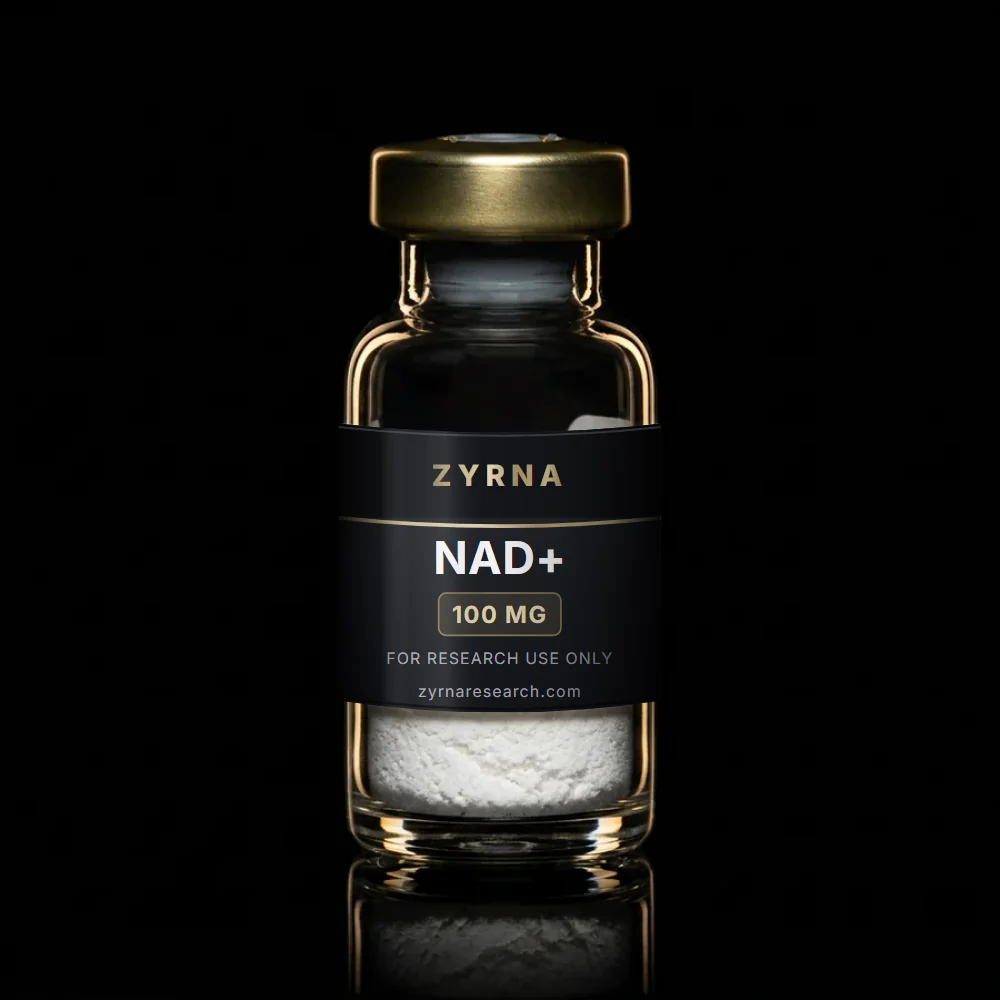
The central redox coenzyme of cellular metabolism and the required substrate for sirtuin and PARP enzyme activity.
Sizes
- 100mg / vial — $100 (currently out of stock)
- 500mg / vial — $300 (currently out of stock)
Specifications
- CAS number: 53-84-9
- Molecular formula: C21H27N7O14P2
- Molecular weight: 663.43 g/mol
- Form: Lyophilised powder
- Storage: −20°C, protected from light
What it is
NAD+ is not a peptide — it is a coenzyme, and arguably the single most important small molecule in cellular metabolism. Every cell in the body uses it. Tissue levels decline measurably with age, and that observation is what put it at the centre of longevity research.
Background
NAD+ (nicotinamide adenine dinucleotide) is a coenzyme present in every living cell and is not a peptide. It is in the catalog because it is stocked in the same lyophilised, research-grade form as the peptides.
How it works
It does two jobs: as a redox carrier it shuttles electrons through glycolysis and the citric acid cycle, and as a consumed substrate it is cleaved by sirtuins and PARPs. When NAD+ runs low those enzymes slow down, and the competition between DNA repair and sirtuin activity for a shrinking pool is the central hypothesis of the field.
Why researchers order it
Direct NAD+ is studied alongside its precursors (NR, NMN) precisely because the bioavailability question is unsettled. The 500mg vial is the practical working size for most bench protocols.
Studied in
- Sirtuin activation and NAD+/NADH ratio studies
- Mitochondrial bioenergetics and DNA-repair models
- Light-sensitive — ships in amber-protected packaging
Handling and storage
Add 2ml to the 100mg vial (50mg/ml) or 5ml to the 500mg (100mg/ml). NAD+ is strongly light-sensitive: shield the vial at all times, refrigerate immediately, and prepare close to when you need it — solutions degrade faster than peptide solutions. Unopened vials keep at −20°C in the light-blocking packaging they ship in.
Stability notes for this sequence
- Lyophilised powder is stable for years at −20°C in the dark and tolerates days at ambient temperature in transit.
Specification in brief
NAD+ is a small molecule rather than a peptide with the molecular formula C21H27N7O14P2 and a molecular weight of 663.43 g/mol, CAS registry number 53-84-9. The vial is sealed and lot-numbered, holds lyophilised powder, and is kept at −20°C protected from light until it ships.
Sizes and price
NAD+ is sold per vial in 2 sizes: 100mg at $100 (currently out of stock) and 500mg at $300 (currently out of stock). Any quantity can be ordered from a single vial upward; ten vials make a sealed box. Shipping is a flat $10 within the United States and free on orders of $250 or more.
Evidence at a glance
The 3 papers cited below are 3 reviews. None is a controlled study of NAD+ in humans, and this page does not claim otherwise.
Also in Longevity
- Epithalon — Epitalon · Ala-Glu-Asp-Gly tetrapeptide
- MOTS-c — Mitochondrial-derived peptide · also listed as MOTC-C
Side by side
Further reading
- Cognitive and longevity peptide comparison
- How to read a certificate of analysis
- Lyophilised peptide storage and stability
- Reconstitution concentration calculator
Certificate of analysis
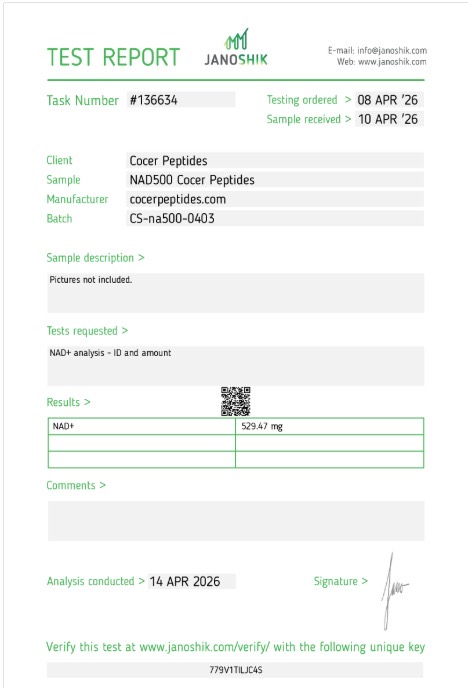
Lot CS-na500-0403, tested 14 Apr 2026 by Janoshik. Identity and amount assay; the laboratory reported no purity figure for this sample.
View the certificate for lot CS-na500-0403 — verification key 779V1TILJC4S, checkable at janoshik.com/verify
References
- Covarrubias AJ et al. (2021). NAD(+) metabolism and its roles in cellular processes during ageing. Nat Rev Mol Cell Biol. PubMed 33353981 · SummaryReview of NAD+ metabolism in ageing: the enzymes that consume it, why levels fall, and the interventions studied.
- Yoshino J et al. (2018). NAD(+) Intermediates: The Biology and Therapeutic Potential of NMN and NR. Cell Metab. PubMed 29249689 · SummaryReview of the NAD+ precursors NMN and NR: uptake, metabolism and the animal evidence.
- Rajman L et al. (2018). Therapeutic Potential of NAD-Boosting Molecules: The In Vivo Evidence. Cell Metab. PubMed 29514064 · SummaryReview of the in vivo evidence for NAD-boosting compounds across tissues and models.
Questions about NAD+
Is NAD+ for human use?
No. Everything Zyrna Research supplies is for laboratory research only. It is not for human or veterinary use, and nothing on this page is a claim of safety or efficacy.
Is there a certificate of analysis for NAD+?
Yes. The manufacturer's certificate for lot CS-na500-0403 is shown on this page. We do not run our own assays; the figure is the manufacturer's, not independent verification.
What sizes does NAD+ come in?
100mg, 500mg. Vials ship in the manufacturer's sealed, lot-numbered packaging; nothing is repackaged or relabelled.
How should NAD+ be stored?
Unopened lyophilised vials at −20°C, protected from light. Prepared solutions at 2–8°C. Repeated freeze–thaw cycles compromise sample integrity for analytical work.
How is it shipped?
From Nashville, Monday to Friday, with carrier tracking on every order. Paid orders are handed to the carrier the next business day; domestic transit is typically 2–4 business days. Lyophilised material is shelf-stable in transit and ships at room temperature.
What if a vial arrives damaged?
Photograph it before opening anything else and email orders@zyrnaresearch.com within 72 hours of delivery. We replace it. Opened or unsealed vials cannot be returned, because storage conditions cannot be verified once they leave our control.
For laboratory research use only. Not for human or veterinary use. Nothing on this page is a claim of safety or efficacy, and none of it has been evaluated by the FDA.