BPC-157
Body Protection Compound · Pentadecapeptide
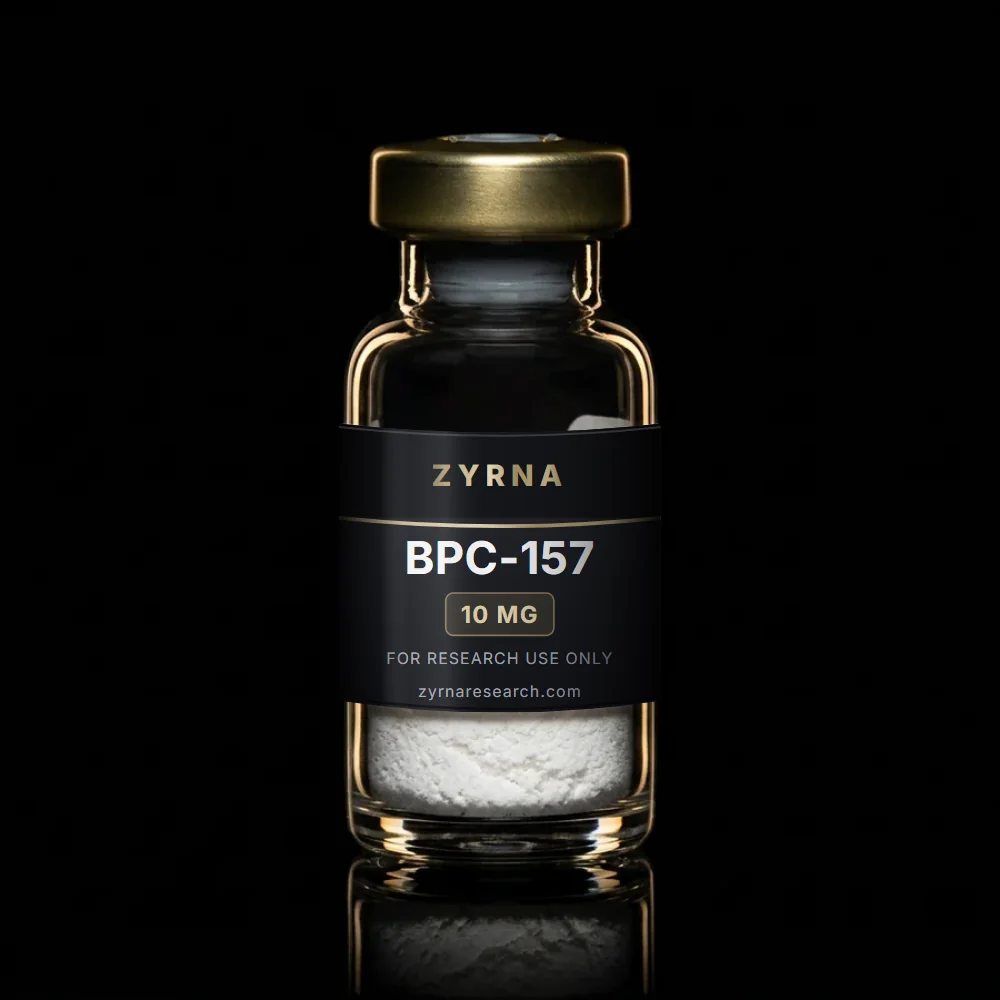
A synthetic pentadecapeptide derived from a protective protein found in gastric juice. One of the most widely requested compounds in soft-tissue and gastrointestinal research models.
Sizes
- 10mg / vial — $80
Specifications
- CAS number: 137525-51-0
- Molecular formula: C62H98N16O22
- Molecular weight: 1419.53 g/mol
- Sequence: Gly-Glu-Pro-Pro-Pro-Gly-Lys-Pro-Ala-Asp-Asp-Ala-Gly-Leu-Val
- Form: Lyophilised powder
- Storage: −20°C, protected from light
What it is
BPC-157 is a 15-amino-acid sequence isolated from a larger protein found naturally in human gastric juice. In the research literature it is characterised as a cytoprotective agent — a compound studied for its apparent ability to help tissue maintain structural integrity under stress. It has become the single most-cited peptide in connective tissue and gastrointestinal research models.
Background
The name is short for Body Protection Compound. The 15-residue sequence was identified in a protein present in human gastric juice. It has been studied almost entirely in animal and cell models and holds no regulatory approval for human use anywhere.
How it works
BPC-157 upregulates VEGF-A expression and promotes angiogenesis — new blood-vessel formation, which is the rate-limiting step in most tissue repair. It also modulates the nitric oxide system and influences growth-hormone receptor expression in fibroblasts, which is the leading explanation for the tendon and ligament findings.
Why researchers order it
Researchers order it because it is unusually stable. Unlike most peptides, BPC-157 resists degradation in gastric acid, which is why it appears in both injectable and oral research protocols. It is the base component of the multi-peptide blends we carry.
Studied in
- Investigated in angiogenesis and tendon-to-bone healing models
- Studied for effects on gastric and intestinal mucosal integrity
- Frequently paired with TB-500 in comparative repair studies
Handling and storage
Add 2ml of bacteriostatic water, directed down the inside wall of the vial rather than onto the powder cake. That gives 5mg/ml. Swirl gently until clear — never shake, as agitation shears peptide bonds. Store unopened vials at −20°C, protected from light; lyophilised powder is stable for years that way and tolerates shipping at ambient temperature. Solutions prepared for analysis should be held at 2–8°C, protected from light. Repeated freeze–thaw cycles compromise sample integrity.
Stability notes for this sequence
- Lyophilised powder is stable for years at −20°C in the dark and tolerates days at ambient temperature in transit.
Specification in brief
BPC-157 is a 15-residue peptide with the molecular formula C62H98N16O22 and a molecular weight of 1419.53 g/mol, CAS registry number 137525-51-0. The vial is sealed and lot-numbered, holds lyophilised powder, and is kept at −20°C protected from light until it ships.
Sizes and price
BPC-157 is sold per vial in one size: 10mg at $80. Any quantity can be ordered from a single vial upward; ten vials make a sealed box. Shipping is a flat $10 within the United States and free on orders of $250 or more.
Evidence at a glance
The 3 papers cited below are 1 cell-culture study and 2 reviews. None is a controlled study of BPC-157 in humans, and this page does not claim otherwise.
Also in Repair & Recovery
- TB-500 — Thymosin β4 Acetate · also listed as TP-500
- KPV — Lysine-Proline-Valine · α-MSH C-terminal tripeptide
Side by side
Further reading
- Repair and recovery peptide comparison
- How to read a certificate of analysis
- Lyophilised peptide storage and stability
- Reconstitution concentration calculator
Certificate of analysis
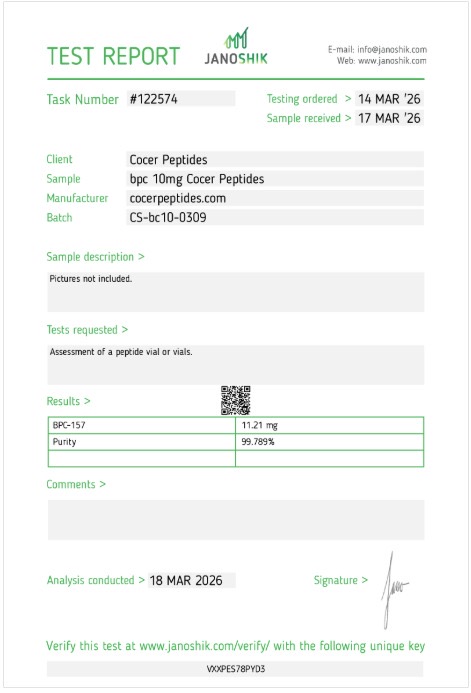
Lot CS-bc10-0309, assayed at 99.789%, tested 18 Mar 2026 by Janoshik.
View the certificate for lot CS-bc10-0309 — verification key VXXPES78PYD3, checkable at janoshik.com/verify
References
- Sikiric P et al. (2016). Brain-gut Axis and Pentadecapeptide BPC 157: Theoretical and Practical Implications. Curr Neuropharmacol. PubMed 27138887 · SummaryReview of the animal literature on BPC 157 across gastrointestinal, vascular and nervous-system models, framed around the brain–gut axis.
- Chang CH et al. (2011). The promoting effect of pentadecapeptide BPC 157 on tendon healing involves tendon outgrowth, cell survival, and cell migration. J Appl Physiol (1985). PubMed 21030672 · SummaryRat Achilles tendon fibroblasts in culture: BPC 157 increased outgrowth, survival and migration, via the FAK–paxillin pathway.
- Sikiric P et al. (2011). Stable gastric pentadecapeptide BPC 157: novel therapy in gastrointestinal tract. Curr Pharm Des. PubMed 21548867 · SummaryReview of BPC 157 in gastrointestinal-tract injury models, including ulcer, fistula and anastomosis healing in rodents.
Questions about BPC-157
Is BPC-157 for human use?
No. Everything Zyrna Research supplies is for laboratory research only. It is not for human or veterinary use, and nothing on this page is a claim of safety or efficacy.
Is there a certificate of analysis for BPC-157?
Yes. The manufacturer's certificate for lot CS-bc10-0309 is shown on this page and reports 99.789% purity. We do not run our own assays; the figure is the manufacturer's, not independent verification.
What sizes does BPC-157 come in?
10mg. Vials ship in the manufacturer's sealed, lot-numbered packaging; nothing is repackaged or relabelled.
How should BPC-157 be stored?
Unopened lyophilised vials at −20°C, protected from light. Prepared solutions at 2–8°C. Repeated freeze–thaw cycles compromise sample integrity for analytical work.
How is it shipped?
From Nashville, Monday to Friday, with carrier tracking on every order. Paid orders are handed to the carrier the next business day; domestic transit is typically 2–4 business days. Lyophilised material is shelf-stable in transit and ships at room temperature.
What if a vial arrives damaged?
Photograph it before opening anything else and email orders@zyrnaresearch.com within 72 hours of delivery. We replace it. Opened or unsealed vials cannot be returned, because storage conditions cannot be verified once they leave our control.
For laboratory research use only. Not for human or veterinary use. Nothing on this page is a claim of safety or efficacy, and none of it has been evaluated by the FDA.