GHK-Cu
Copper Peptide · Copper tripeptide-1
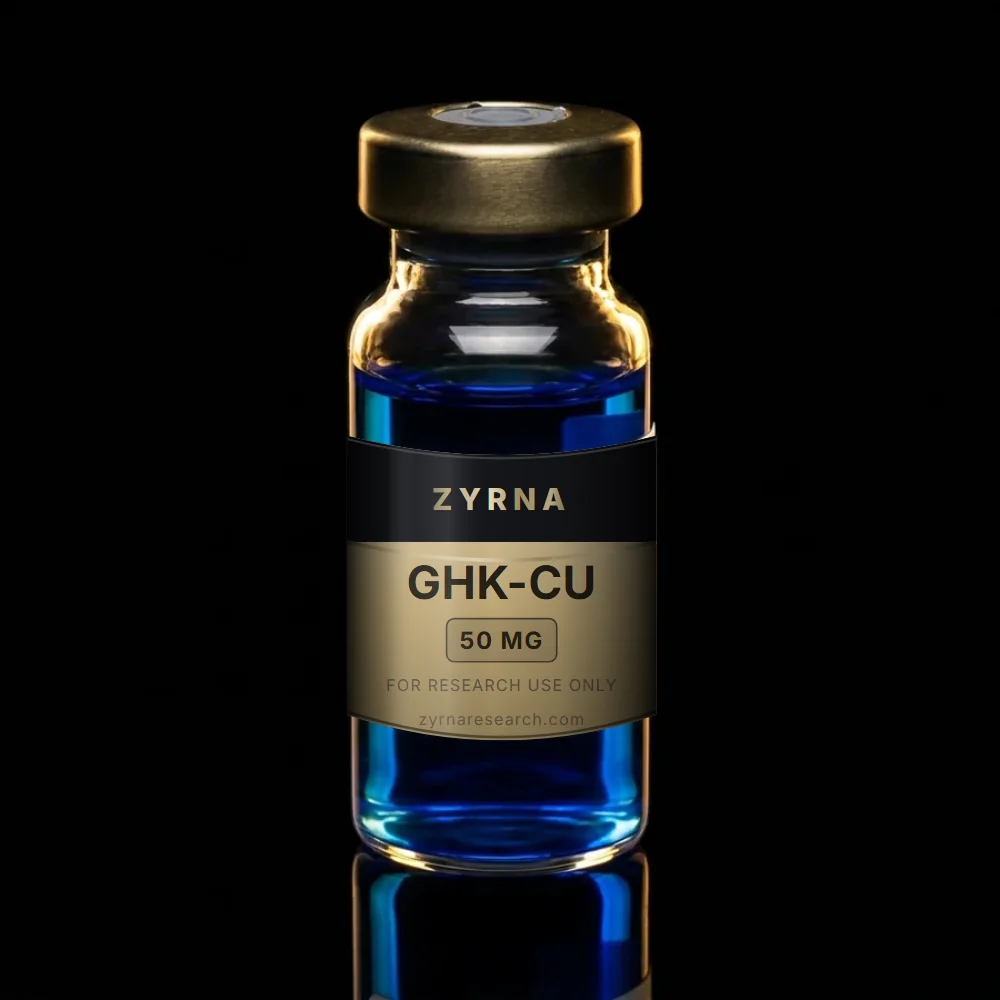
A naturally occurring copper-binding tripeptide with a deep, distinctive blue colour in solution. The most studied compound in dermal and follicular research.
Sizes
- 50mg / vial — $40
- 100mg / vial — $80
Specifications
- CAS number: 89030-95-5
- Molecular formula: C14H22N6O4·Cu
- Molecular weight: 403.94 g/mol
- Sequence: Gly-His-Lys : Cu(II)
- Form: Lyophilised powder
- Storage: −20°C, protected from light
What it is
GHK-Cu is a three-amino-acid peptide bound to a copper(II) ion. It occurs naturally in human plasma, where concentrations fall by roughly two-thirds between age twenty and age sixty — a decline that tracks closely with measurable changes in skin structure. It is the most-studied compound in dermal research by a wide margin.
Background
GHK-Cu was identified by Loren Pickart in 1973 as a component of human plasma. Its concentration in plasma is documented to decline with age, which is the observation most of the research literature starts from.
How it works
The copper is the active part. GHK carries copper ions to the enzymes that need them — most importantly lysyl oxidase, which cross-links collagen and elastin into a functioning matrix. Gene-expression studies also show it upregulating collagen synthesis while downregulating the metalloproteinases that break the matrix down.
Why researchers order it
It is inexpensive, exceptionally well characterised, and visually unmistakable — the copper complex gives a deep blue solution that tells you immediately the complex is intact. It is the largest component by mass in our four-peptide blend.
Studied in
- Collagen and glycosaminoglycan synthesis models
- Dermal remodelling and wound-repair literature
- Base component of our four-peptide blend
Handling and storage
Add 5ml to the 50mg vial or 10ml to the 100mg, both giving 10mg/ml. The solution will turn deep blue — that is the intact copper complex and is expected. A solution that has gone green or colourless means the complex has dissociated and the vial should be discarded. Protect from light at all times; store unopened vials at −20°C and reconstituted solution at 2–8°C.
Stability notes for this sequence
- Supplied as a copper complex; the blue colour is the complex itself. Keep it away from chelating buffers and reducing agents.
- Lyophilised powder is stable for years at −20°C in the dark and tolerates days at ambient temperature in transit.
Specification in brief
GHK-Cu is the copper(II) complex of the tripeptide Gly-His-Lys with the molecular formula C14H22N6O4·Cu and a molecular weight of 403.94 g/mol, CAS registry number 89030-95-5. The vial is sealed and lot-numbered, holds lyophilised powder, and is kept at −20°C protected from light until it ships.
Sizes and price
GHK-Cu is sold per vial in 2 sizes: 50mg at $40 and 100mg at $80. Any quantity can be ordered from a single vial upward; ten vials make a sealed box. Shipping is a flat $10 within the United States and free on orders of $250 or more.
Evidence at a glance
The 3 papers cited below are 1 cell-culture study and 2 reviews. None is a controlled study of GHK-Cu in humans, and this page does not claim otherwise.
Also in Peptide Blends
- BPC-157 + TB-500 — BPC-157 + TB-500 · 1:1 blend
- Melanotan II — Melanocortin receptor agonist · α-MSH analog
- GHK-Cu + BPC-157 + TB-500 + KPV — BPC-157 + TB-500 + GHK-Cu + KPV
Side by side
Further reading
- Repair and recovery peptide comparison
- How to read a certificate of analysis
- Lyophilised peptide storage and stability
- Reconstitution concentration calculator
Certificate of analysis
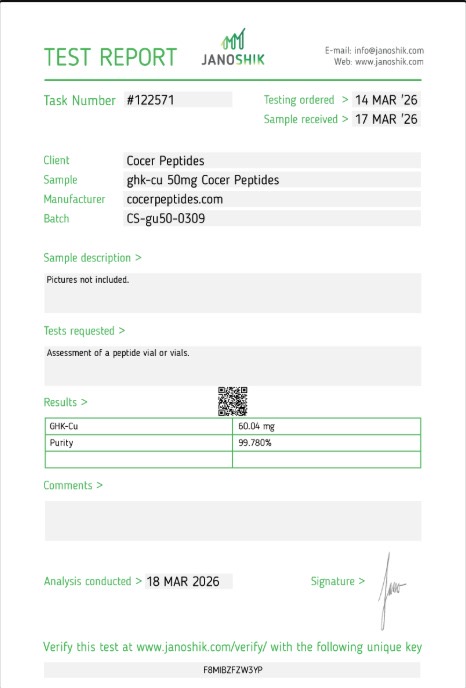
Lot CS-gu50-0309, assayed at 99.780%, tested 18 Mar 2026 by Janoshik.
View the certificate for lot CS-gu50-0309 — verification key F8MIBZFZW3YP, checkable at janoshik.com/verify
References
- Pickart L et al. (2015). GHK Peptide as a Natural Modulator of Multiple Cellular Pathways in Skin Regeneration. Biomed Res Int. PubMed 26236730 · SummaryReview of GHK as a modulator of gene expression, collagen synthesis and wound-healing pathways in skin.
- Pickart L & Margolina A (2018). Regenerative and Protective Actions of the GHK-Cu Peptide in the Light of the New Gene Data. Int J Mol Sci. PubMed 29986520 · SummaryReview of GHK-Cu against the Broad Institute gene-expression data: which gene sets it appears to reset.
- Maquart FX et al. (1988). Stimulation of collagen synthesis in fibroblast cultures by the tripeptide-copper complex glycyl-L-histidyl-L-lysine-Cu2+. FEBS Lett. PubMed 3169264 · SummaryFibroblast cultures: the GHK–copper complex stimulated collagen synthesis at nanomolar concentrations.
Questions about GHK-Cu
Is GHK-Cu for human use?
No. Everything Zyrna Research supplies is for laboratory research only. It is not for human or veterinary use, and nothing on this page is a claim of safety or efficacy.
Is there a certificate of analysis for GHK-Cu?
Yes. The manufacturer's certificate for lot CS-gu50-0309 is shown on this page and reports 99.780% purity. We do not run our own assays; the figure is the manufacturer's, not independent verification.
What sizes does GHK-Cu come in?
50mg, 100mg. Vials ship in the manufacturer's sealed, lot-numbered packaging; nothing is repackaged or relabelled.
How should GHK-Cu be stored?
Unopened lyophilised vials at −20°C, protected from light. Prepared solutions at 2–8°C. Repeated freeze–thaw cycles compromise sample integrity for analytical work.
How is it shipped?
From Nashville, Monday to Friday, with carrier tracking on every order. Paid orders are handed to the carrier the next business day; domestic transit is typically 2–4 business days. Lyophilised material is shelf-stable in transit and ships at room temperature.
What if a vial arrives damaged?
Photograph it before opening anything else and email orders@zyrnaresearch.com within 72 hours of delivery. We replace it. Opened or unsealed vials cannot be returned, because storage conditions cannot be verified once they leave our control.
For laboratory research use only. Not for human or veterinary use. Nothing on this page is a claim of safety or efficacy, and none of it has been evaluated by the FDA.