GHK-Cu + BPC-157 + TB-500 + KPV
BPC-157 + TB-500 + GHK-Cu + KPV
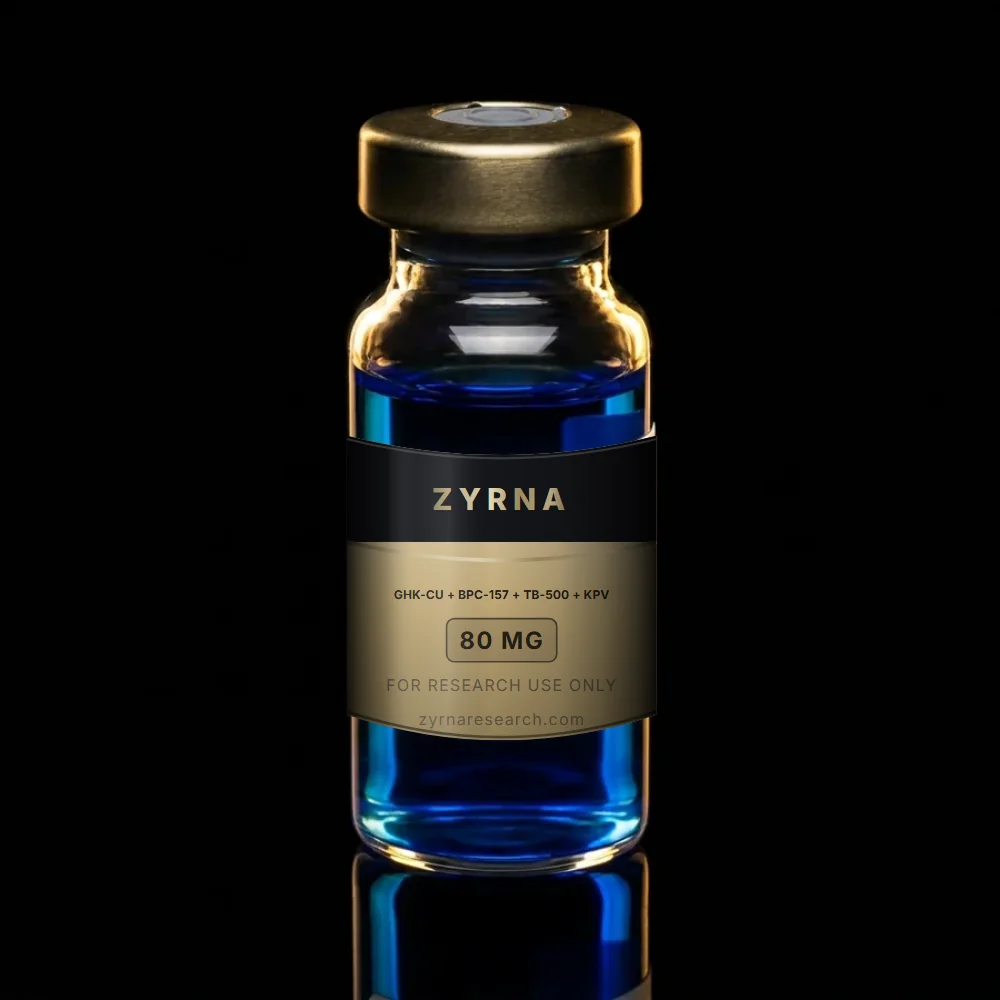
Four compounds and 80mg of total peptide mass per vial — the most complete blend we carry.
Sizes
- 80mg / vial — 10 + 10 + 50 + 10mg — $160
Specifications
- Blend contents: BPC-157 · 10mg · TB-500 · 10mg · GHK-Cu · 50mg · KPV · 10mg
- Form: Lyophilised powder
- Storage: −20°C, protected from light
What it is
This blend is BPC-157, TB-500 and GHK-Cu co-lyophilised with 10mg of KPV — four compounds and 80mg of total peptide mass in a single vial. It is the most complete blend we carry and covers four distinct pathways from one reconstitution.
Background
This is a co-lyophilised four-compound combination. Each component is separately characterised in the literature; there is no published research on the four-way combination itself.
How it works
BPC-157 handles angiogenesis, TB-500 handles cell migration, GHK-Cu delivers copper to the collagen cross-linking enzymes, and KPV — the fourth addition — interferes with NF-κB, addressing the inflammatory signalling environment the other three operate in.
Why researchers order it
Highest total peptide mass per vial in the catalog. It reconstitutes to a deep blue solution because GHK-Cu is the dominant component by mass.
Studied in
- Repair, dermal and inflammatory pathways in one vial
- Four-compound blend, single reconstitution
- Highest total peptide mass per vial in the catalog
Handling and storage
Add 3ml of bacteriostatic water to the whole vial for roughly 27mg/ml of combined peptide. Deep blue is expected from the GHK-Cu. Protect from light, refrigerate after reconstitution, avoid freeze–thaw cycling. Unopened vials keep at −20°C.
Stability notes for this sequence
- Lyophilised powder is stable for years at −20°C in the dark and tolerates days at ambient temperature in transit.
Specification in brief
GHK-Cu + BPC-157 + TB-500 + KPV is a fixed-ratio blend of BPC-157 · 10mg, TB-500 · 10mg, GHK-Cu · 50mg, KPV · 10mg in one vial; each component is assayed separately on the certificate, so the blend carries a content figure per peptide and no single purity number. The vial is sealed and lot-numbered, holds lyophilised powder, and is kept at −20°C protected from light until it ships.
Sizes and price
GHK-Cu + BPC-157 + TB-500 + KPV is sold per vial in one size: 80mg at $160. Any quantity can be ordered from a single vial upward; ten vials make a sealed box. Shipping is a flat $10 within the United States and free on orders of $250 or more.
Evidence at a glance
The 4 papers cited below are 1 animal study and 3 reviews. None is a controlled study of GHK-Cu + BPC-157 + TB-500 + KPV in humans, and this page does not claim otherwise.
Also in Peptide Blends
- BPC-157 + TB-500 — BPC-157 + TB-500 · 1:1 blend
- Melanotan II — Melanocortin receptor agonist · α-MSH analog
- GHK-Cu — Copper Peptide · Copper tripeptide-1
Further reading
- Repair and recovery peptide comparison
- How to read a certificate of analysis
- Lyophilised peptide storage and stability
- Reconstitution concentration calculator
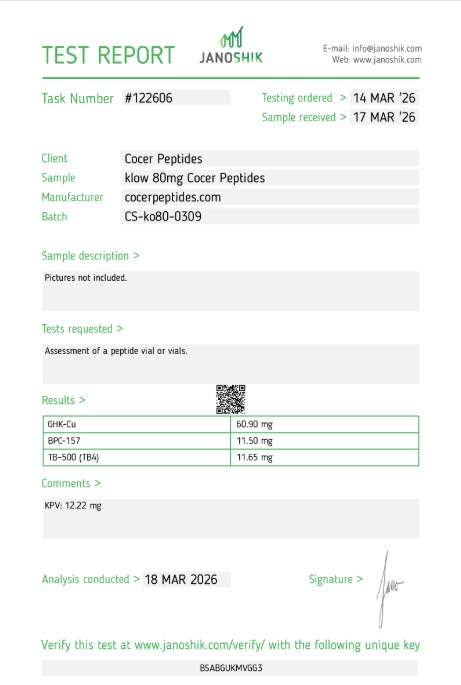
Certificate of analysis
Lot CS-ko80-0309, tested 18 Mar 2026 by Janoshik.
View the certificate for lot CS-ko80-0309 — verification key BSABGUKMVGG3, checkable at janoshik.com/verify
References
- Pickart L et al. (2015). GHK Peptide as a Natural Modulator of Multiple Cellular Pathways in Skin Regeneration. Biomed Res Int. PubMed 26236730 · SummaryReview of GHK as a modulator of gene expression, collagen synthesis and wound-healing pathways in skin.
- Sikiric P et al. (2016). Brain-gut Axis and Pentadecapeptide BPC 157: Theoretical and Practical Implications. Curr Neuropharmacol. PubMed 27138887 · SummaryReview of the animal literature on BPC 157 across gastrointestinal, vascular and nervous-system models, framed around the brain–gut axis.
- Goldstein AL et al. (2012). Thymosin β4: a multi-functional regenerative peptide. Basic properties and clinical applications. Expert Opin Biol Ther. PubMed 22074294 · SummaryReview of thymosin β4 as an actin-sequestering peptide, its role in wound healing and cardiac repair, and early clinical work.
- Dalmasso G et al. (2008). PepT1-mediated tripeptide KPV uptake reduces intestinal inflammation. Gastroenterology. PubMed 18061177 · SummaryKPV is taken up by the PepT1 transporter in intestinal epithelial cells and reduced inflammation in two mouse colitis models.
Questions about GHK-Cu + BPC-157 + TB-500 + KPV
Is GHK-Cu + BPC-157 + TB-500 + KPV for human use?
No. Everything Zyrna Research supplies is for laboratory research only. It is not for human or veterinary use, and nothing on this page is a claim of safety or efficacy.
Is there a certificate of analysis for GHK-Cu + BPC-157 + TB-500 + KPV?
Yes. The manufacturer's certificate for lot CS-ko80-0309 is shown on this page. We do not run our own assays; the figure is the manufacturer's, not independent verification.
What sizes does GHK-Cu + BPC-157 + TB-500 + KPV come in?
80mg / vial — 10 + 10 + 50 + 10mg. Vials ship in the manufacturer's sealed, lot-numbered packaging; nothing is repackaged or relabelled.
How should GHK-Cu + BPC-157 + TB-500 + KPV be stored?
Unopened lyophilised vials at −20°C, protected from light. Prepared solutions at 2–8°C. Repeated freeze–thaw cycles compromise sample integrity for analytical work.
How is it shipped?
From Nashville, Monday to Friday, with carrier tracking on every order. Paid orders are handed to the carrier the next business day; domestic transit is typically 2–4 business days. Lyophilised material is shelf-stable in transit and ships at room temperature.
What if a vial arrives damaged?
Photograph it before opening anything else and email orders@zyrnaresearch.com within 72 hours of delivery. We replace it. Opened or unsealed vials cannot be returned, because storage conditions cannot be verified once they leave our control.
For laboratory research use only. Not for human or veterinary use. Nothing on this page is a claim of safety or efficacy, and none of it has been evaluated by the FDA.