Retatrutide
Triple agonist · GLP-1 / GIP / Glucagon
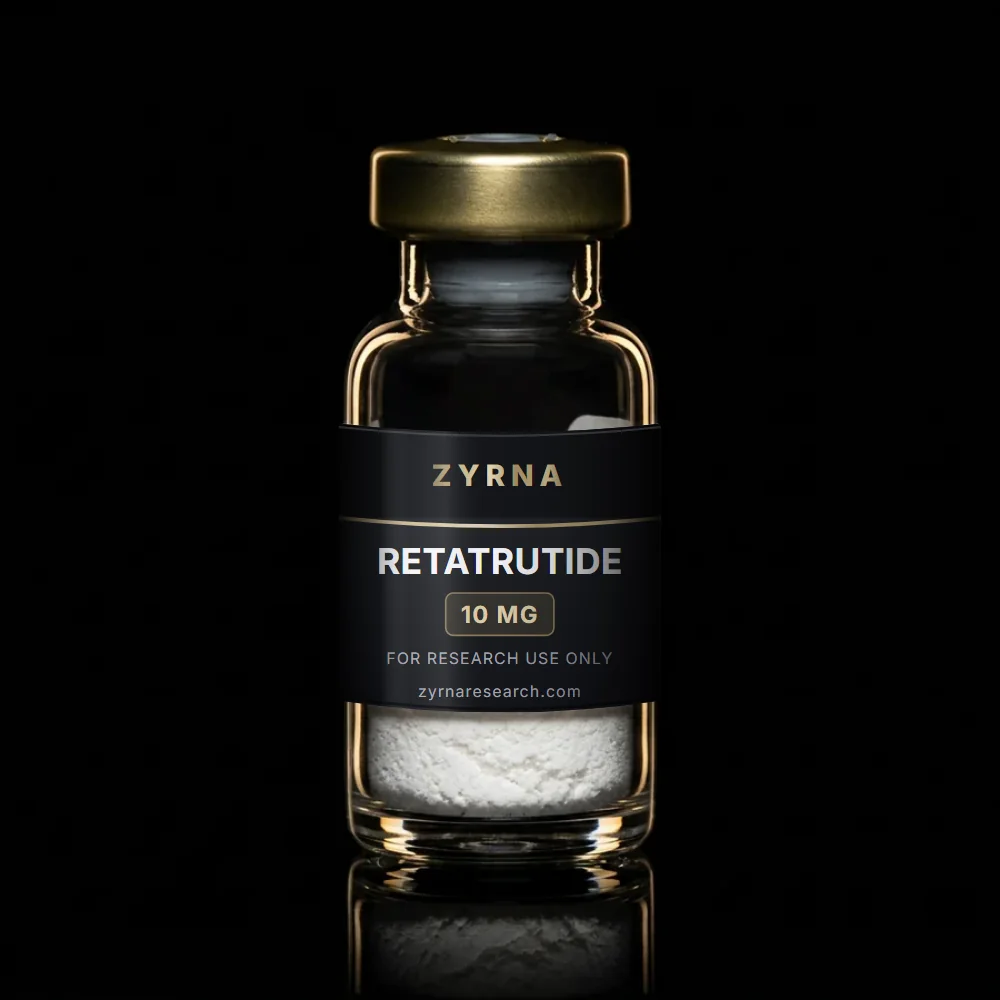
A single-molecule triple receptor agonist acting on GLP-1, GIP and glucagon receptors. The most requested compound in current metabolic research.
Sizes
- 10mg / vial — $110
- 20mg / vial — $200 (currently out of stock)
Specifications
- CAS number: 2381089-83-2
- Molecular formula: C221H342N46O68
- Molecular weight: 4731.3 g/mol
- Form: Lyophilised powder
- Storage: −20°C, protected from light
What it is
Retatrutide is a single engineered peptide that activates three different metabolic receptors at once. It represents the current frontier of incretin research — the third generation after single-agonist and dual-agonist molecules.
Background
Retatrutide carries the Eli Lilly development code LY3437943. It is a 39-amino-acid synthetic peptide and, at the time of writing, remains an investigational compound in late-stage clinical trials. It is not an approved medicine in any country, and the research vial is not the trial material.
How it works
Three targets, three jobs. GLP-1 receptor activation slows gastric emptying and drives glucose-dependent insulin release; GIP activation modulates how adipose tissue handles nutrient load; the glucagon receptor — the novel addition — raises energy expenditure, which pushes opposite to the other two.
Why researchers order it
It is the most requested compound in our catalog and the most active area of published metabolic research right now. We stock the two concentrations that cover the bulk of published dose-response work.
Studied in
- Triple incretin receptor binding-affinity studies
- Energy-expenditure and adipose-tissue models
- Two concentrations for dose-comparison work
Handling and storage
Add 2ml of bacteriostatic water down the vial wall: 5mg/ml on the 10mg vial, 10mg/ml on the 20mg. Swirl gently until fully clear before use. Store unopened vials at −20°C, protected from light; lyophilised powder is stable for years that way and tolerates shipping at ambient temperature. Solutions prepared for analysis should be held at 2–8°C, protected from light. Repeated freeze–thaw cycles compromise sample integrity.
Stability notes for this sequence
- A long acylated peptide. Repeated warming and cooling of a solution can cause aggregation, seen as cloudiness; aliquot rather than re-cool the same vial.
- Lyophilised powder is stable for years at −20°C in the dark and tolerates days at ambient temperature in transit.
Specification in brief
Retatrutide is a synthetic peptide with the molecular formula C221H342N46O68 and a molecular weight of 4731.3 g/mol, CAS registry number 2381089-83-2. The vial is sealed and lot-numbered, holds lyophilised powder, and is kept at −20°C protected from light until it ships.
Sizes and price
Retatrutide is sold per vial in 2 sizes: 10mg at $110 and 20mg at $200 (currently out of stock). Any quantity can be ordered from a single vial upward; ten vials make a sealed box. Shipping is a flat $10 within the United States and free on orders of $250 or more.
Evidence at a glance
The 3 papers cited below are 3 studies in humans. The human data belong to the pharmaceutical forms of the compound, not to any research-grade vial.
Also in Metabolic
- Tirzepatide — Dual agonist · GIP / GLP-1
Side by side
Further reading
- GLP-1 family comparison
- How to read a certificate of analysis
- Lyophilised peptide storage and stability
- Reconstitution concentration calculator
Certificate of analysis
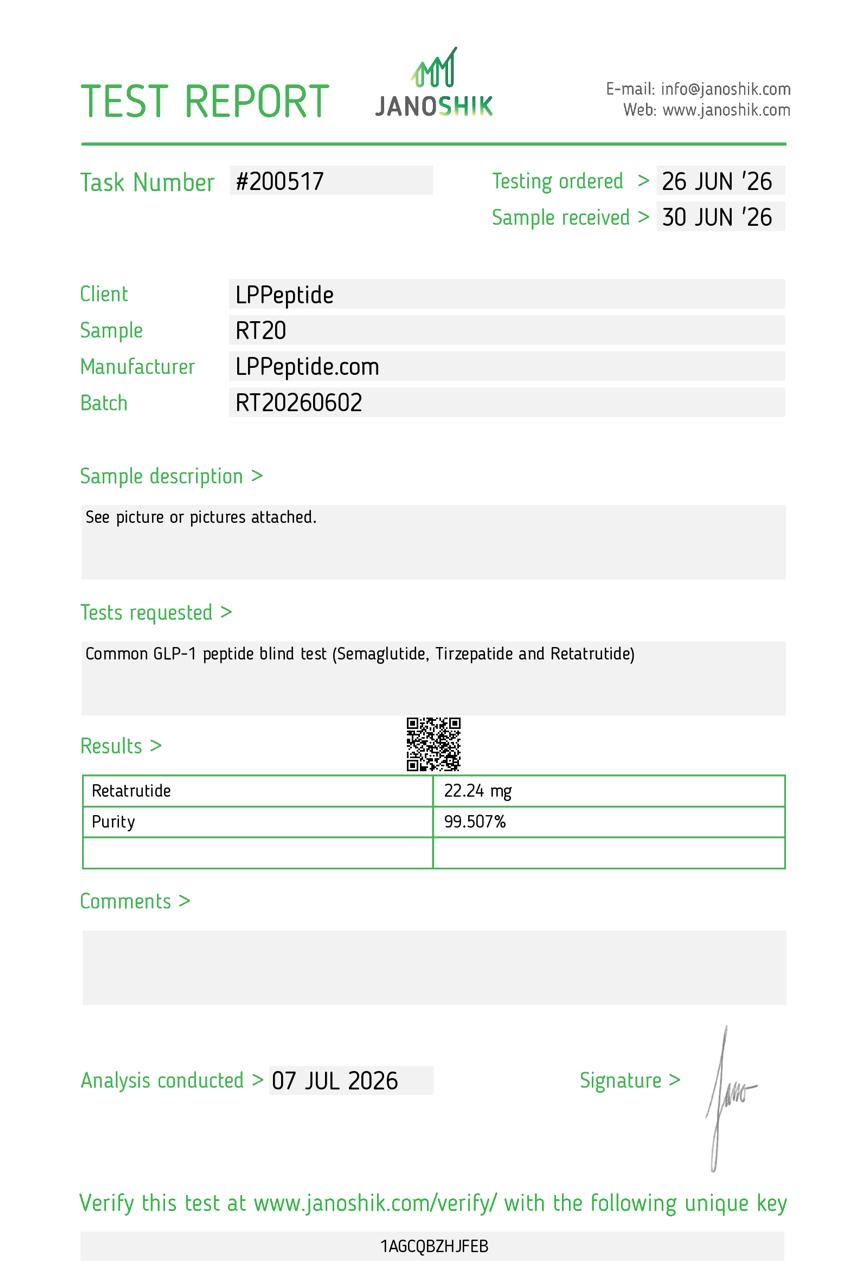
Lot RT20260602, assayed at 99.507%, tested 07 Jul 2026 by Janoshik. Assay run on the 20mg fill of this same batch.
View the certificate for lot RT20260602
References
- Jastreboff AM et al. (2023). Triple-Hormone-Receptor Agonist Retatrutide for Obesity - A Phase 2 Trial. N Engl J Med. PubMed 37366315 · SummaryPhase 2, 338 adults with obesity: mean weight change of −24.2% at 48 weeks on 12 mg weekly, against −2.1% on placebo.
- Rosenstock J et al. (2023). Retatrutide, a GIP, GLP-1 and glucagon receptor agonist, for people with type 2 diabetes: a randomised, double-blind, placebo and active-controlled, parallel-group, phase 2 trial conducted in the USA. Lancet. PubMed 37385280 · SummaryPhase 2 in type 2 diabetes, 36 weeks: HbA1c fell by up to about two percentage points and body weight by up to about 17% at the highest dose.
- Coskun T et al. (2022). LY3437943, a novel triple glucagon, GIP, and GLP-1 receptor agonist for glycemic control and weight loss: From discovery to clinical proof of concept. Cell Metab. PubMed 35985340 · SummaryThe discovery paper: how the three receptor activities were balanced in one molecule, with first-in-human data supporting once-weekly dosing.
Questions about Retatrutide
Is Retatrutide for human use?
No. Everything Zyrna Research supplies is for laboratory research only. It is not for human or veterinary use, and nothing on this page is a claim of safety or efficacy.
Is there a certificate of analysis for Retatrutide?
Yes. The manufacturer's certificate for lot RT20260602 is shown on this page and reports 99.507% purity. We do not run our own assays; the figure is the manufacturer's, not independent verification.
What sizes does Retatrutide come in?
10mg, 20mg. Vials ship in the manufacturer's sealed, lot-numbered packaging; nothing is repackaged or relabelled.
How should Retatrutide be stored?
Unopened lyophilised vials at −20°C, protected from light. Prepared solutions at 2–8°C. Repeated freeze–thaw cycles compromise sample integrity for analytical work.
How is it shipped?
From Nashville, Monday to Friday, with carrier tracking on every order. Paid orders are handed to the carrier the next business day; domestic transit is typically 2–4 business days. Lyophilised material is shelf-stable in transit and ships at room temperature.
What if a vial arrives damaged?
Photograph it before opening anything else and email orders@zyrnaresearch.com within 72 hours of delivery. We replace it. Opened or unsealed vials cannot be returned, because storage conditions cannot be verified once they leave our control.
For laboratory research use only. Not for human or veterinary use. Nothing on this page is a claim of safety or efficacy, and none of it has been evaluated by the FDA.